Zero-Trust Communication: Building Strong Digital Privacy 2025
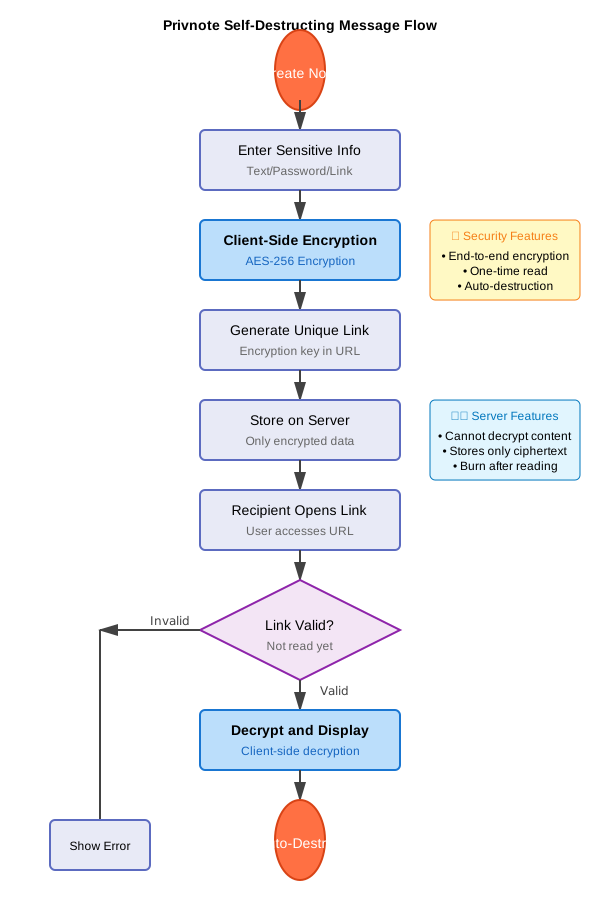
Understanding Zero-Trust Communication in 2025
Zero-trust communication represents an advanced approach to digital privacy protection, operating on the fundamental principle that no communication channel, device, or user can be inherently trusted. In 2025, as cyber threats become increasingly sophisticated, zero-trust communication has evolved from a security concept to an important privacy strategy that assumes every interaction could be compromised.
Unlike traditional security models that trust internal networks and verified users, zero-trust communication requires continuous verification at every step of the communication process. This approach ensures that even if one component of the system is compromised, sensitive information remains protected through multiple layers of security and automatic privacy measures.
Core principles of zero-trust communication include:
- Never Trust, Always Verify - Every communication interaction requires authentication
- Least Privilege Access - Users receive only the minimum access necessary
- Assume Breach - Design systems assuming someone may already be inside
- Continuous Monitoring - Real-time verification of all communication activities
The Trust Crisis in Digital Communication
Recent cybersecurity reports show that 68% of security breaches in 2025 involved trusted internal communications that were compromised. Traditional trust-based communication systems failed to detect these breaches for an average of 287 days, highlighting the urgent need for zero-trust communication approaches that eliminate trust assumptions entirely.
Building Strong Privacy Through Zero-Trust Principles
Creating strong digital privacy requires implementing zero-trust principles at every level of communication infrastructure. This comprehensive approach ensures that privacy protection doesn't depend on trust relationships but on continuous verification and cryptographic guarantees.
Multi-Layer Identity Verification
Zero-trust communication implements continuous identity verification through:
- Multi-factor authentication for every communication session
- Biometric verification integrated with message access controls
- Device fingerprinting to ensure communication originates from trusted hardware
- Behavioral analysis to detect anomalous communication patterns
End-to-End Encrypted Communication Paths
Unbreakable privacy requires encryption that never relies on trusted intermediaries:
- Client-side encryption that processes messages before transmission
- Zero-knowledge architecture where service providers cannot access content
- Perfect forward secrecy ensuring past communications remain secure
- Quantum-resistant algorithms protecting against future computational threats
Automated Privacy Enforcement
Zero-trust systems automatically enforce privacy without human intervention:
- Self-destructing messages that eliminate evidence trails automatically
- Smart contracts governing message lifecycle and destruction
- Automated compliance checking for regulatory privacy requirements
- Real-time threat detection with automatic privacy escalation
Advanced Zero-Trust Communication Technologies
The implementation of strong digital privacy relies on advanced technologies that eliminate trust dependencies while maintaining usability and efficiency:
Cryptographic Proof Systems
Modern zero-trust communication uses advanced cryptography to provide mathematical proof of privacy:
- Zero-knowledge proofs that verify identity without revealing information
- Homomorphic encryption allowing computation on encrypted data
- Secure multi-party computation for collaborative privacy protection
- Blockchain-based verification for transparent destruction proof
Distributed Trust Networks
Eliminate single points of failure through distributed privacy protection:
- Decentralized key management preventing central compromise
- Distributed message storage with redundant privacy protection
- Consensus-based destruction requiring multiple system confirmations
- Peer-to-peer validation eliminating trusted authority requirements
Adaptive Security Mechanisms
Zero-trust systems adapt automatically to emerging threats:
- Machine learning threat detection with automatic privacy enhancement
- Dynamic encryption upgrade based on current threat landscape
- Contextual access controls that adjust based on risk assessment
- Predictive privacy protection anticipating future vulnerabilities
Industry Applications of Zero-Trust Communication
Zero-trust communication principles are being implemented across industries where strong privacy is essential for operations, compliance, and competitive advantage:
Financial Services Innovation
Banking and financial institutions implement zero-trust communication for:
- Client transaction discussions with cryptographic privacy guarantees
- Internal fraud investigation communications with automatic destruction
- Regulatory compliance reporting with verifiable privacy protection
- Cross-border financial communications with jurisdiction-proof encryption
Healthcare Privacy Protection
Medical organizations use zero-trust principles for:
- Patient information sharing with mathematical privacy proof
- Medical research collaboration with zero-knowledge data sharing
- Emergency medical communications with automatic HIPAA compliance
- Pharmaceutical development discussions with IP protection guarantees
Government and Defense Applications
Government agencies implement zero-trust communication for:
- Classified information sharing with unbreakable security guarantees
- Inter-agency collaboration with compartmentalized privacy protection
- Diplomatic communications with quantum-resistant encryption
- National security discussions with verified destruction capabilities
Implementation Strategy for Zero-Trust Communication
Successfully implementing zero-trust communication requires a systematic approach that addresses technology, processes, and organizational culture:
Phase 1: Assessment and Planning
Begin zero-trust implementation with comprehensive evaluation:
- Audit existing communication systems for trust dependencies
- Identify sensitive information flows requiring unbreakable privacy
- Assess current security capabilities and infrastructure requirements
- Develop phased implementation roadmap for zero-trust adoption
Phase 2: Technology Infrastructure
Build the technical foundation for zero-trust communication:
- Deploy advanced encryption systems with zero-knowledge architecture
- Implement multi-factor authentication for all communication access
- Establish continuous monitoring and verification systems
- Create automated privacy enforcement and compliance checking
Phase 3: Process Integration
Integrate zero-trust principles into organizational workflows:
- Develop zero-trust communication policies and procedures
- Train staff on continuous verification requirements
- Establish incident response procedures for zero-trust environments
- Create metrics and monitoring for zero-trust effectiveness
Experience Zero-Trust Communication
Discover how zero-trust communication principles can create unbreakable privacy for your most sensitive information. Start with advanced self-destructing messages and explore enterprise-grade zero-trust features.
Try Zero-Trust PrivacyMeasuring Zero-Trust Communication Effectiveness
Successful zero-trust communication implementation requires comprehensive measurement and continuous improvement:
Security Performance Metrics
- Reduction in successful communication-based security incidents
- Time to detect and respond to communication anomalies
- Percentage of communications using zero-trust verification
- Success rate of automated privacy enforcement mechanisms
Privacy Protection Indicators
- Verification rate of successful message destruction
- Compliance score for regulatory privacy requirements
- Reduction in unauthorized access to sensitive communications
- Improvement in privacy incident response times
Operational Efficiency Measures
- User adoption rate of zero-trust communication tools
- Time savings from automated privacy compliance
- Reduction in manual security verification tasks
- Cost savings from prevented privacy incidents
The Future of Zero-Trust Communication
As we advance through 2025 and beyond, zero-trust communication continues evolving with emerging technologies and changing threat landscapes:
Quantum-Enhanced Zero-Trust
Quantum technologies will enhance zero-trust communication through:
- Quantum key distribution for mathematically proven secure communication
- Quantum random number generation for unbreakable encryption keys
- Quantum-resistant algorithms protecting against future computational threats
- Quantum verification systems for instant authenticity confirmation
AI-Powered Privacy Protection
Artificial intelligence will automate zero-trust communication through:
- Intelligent threat prediction with proactive privacy enhancement
- Automated policy enforcement based on communication context
- Smart privacy controls that adapt to changing risk conditions
- Machine learning optimization of zero-trust verification processes
Conclusion: The Importance of Strong Privacy
Zero-trust communication represents not just an advancement in security technology, but an important requirement for protecting sensitive information in our increasingly connected world. By eliminating trust assumptions and implementing continuous verification, we can achieve strong digital privacy that helps protect against sophisticated attacks.
The transition to zero-trust communication requires commitment and investment, but the benefits—including prevention of costly data breaches, regulatory compliance, and competitive advantage—far outweigh the implementation costs. Organizations that embrace zero-trust principles today position themselves for success in a future where privacy protection is not optional but essential.
As cyber threats continue evolving and regulatory requirements become more stringent, zero-trust communication provides the foundation for sustainable privacy protection. The question is not whether to implement zero-trust communication, but how quickly you can begin the transformation to strong digital privacy.
Start your zero-trust communication journey today and experience the confidence that comes from knowing your sensitive information is protected by advanced privacy technologies. In 2025, strong privacy is achievable through zero-trust communication principles.